|
Karpathos Island
300 sq km,
Population: 4.600
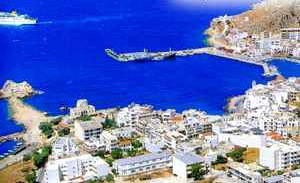 Karpathos is
located between Rhodos and Crete and belongs to the
Dodecanese, which means "the twelve". In addition to
the capital Karpathos (formerly called Pigadia) there are
about ten main villages with approximately 5.000 people in
total. Many of the Karpathiens have immigrated to the USA and
Australia for economic reasons. Most of them use to work hard,
but they come back regularily for elections, vacation or
family celebrations. The situation leads to an increasing
contrast between lively traditons and Americanism, forming the
face of Karpathos' society today. Karpathos is
located between Rhodos and Crete and belongs to the
Dodecanese, which means "the twelve". In addition to
the capital Karpathos (formerly called Pigadia) there are
about ten main villages with approximately 5.000 people in
total. Many of the Karpathiens have immigrated to the USA and
Australia for economic reasons. Most of them use to work hard,
but they come back regularily for elections, vacation or
family celebrations. The situation leads to an increasing
contrast between lively traditons and Americanism, forming the
face of Karpathos' society today.
Karpathos is
a long and narrow island with many different faces. The southern
part of the island is low with gentle hills and sandy beaches.
The byzantine city of Thaetho, was situated here, at the area
where the airport is today. Of the city only extensive sherds
and demolished edifices are still to be traced today.
The middle
southern part of the island, is marked with low stony
mountains, valleys dedicated to agriculture, and long sandy
beaches. The capital
of Karpathos, the town of Karpathos or Pigadia, is situated on
this part of the island, on the site of the ancient greek city
of Karpathos. Another
seven villages, Menetes, Arkasa, Phoeniki, Pyles, Othos Volada
and Aperi, belong to this part of the island, which the
Karpathiotes call Kato Horia (lower villages).
Aperi was
the old capital of Karpathos, and is still the seat of the
archbishop. Above the village on the top of the commanding
hill of Kastro, there are the remains of medieval
fortifications. A nice path to walk up the hill, begins at the
village of Volada (30min).
From Volada
you can also set off to conquer the island's highest peak
(1215m), which bears the unusual for a mountain name of
Kalolimni, meaning "Good Lake". Take the road to
Othos, and before reaching the village, take the turn to the
right (north), towards the plateau of Lastos. It is said that
Lastos was in prehistoric times a lake, formed by the water
from the springs of Kalolimni. In recored history times,
Lastos has been producing excellent wine. There are still a
few farmers' cottages in the platau, the "stavli"
where the Karpathiotes resided during the harvest. The road
continues from Lastos up the mountain to a camp of relay
transmitters' installations. You can either follow the road or
trace and follow goat paths. You will have reached the peak in
4 hours.
Menetes and
Othos were built after the destruction by the pirates of the
byzantine city of Thaetho, by the city's remaining
inhabitants.
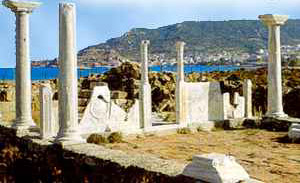 Arkasa and
Phoeniki, lay at the area of the ancient greek city of
Arkesea. The villages were built only as recently as the the
end of last century. As it has been common practice, the
builders used material of the ancient Arkesea to built their
houses. The big church of Menetes was also built with ancient
stones capitals and columns, which were carried on donkeys
from Arkesia up to Menetes. The builders seem to have been too
eager to carry the ancient material, so that 4 columns
remained unused, standing now out side the church! Arkasa and
Phoeniki, lay at the area of the ancient greek city of
Arkesea. The villages were built only as recently as the the
end of last century. As it has been common practice, the
builders used material of the ancient Arkesea to built their
houses. The big church of Menetes was also built with ancient
stones capitals and columns, which were carried on donkeys
from Arkesia up to Menetes. The builders seem to have been too
eager to carry the ancient material, so that 4 columns
remained unused, standing now out side the church!
All the
cottages of the area were also built with ancient material,
but the long story of "the city for the taking" does
not stop here.
Every
traveller in the past several senturies has to record a
diminuition.
Ludwig Ross,
the Austrian archeologist who visited and described the site
in 1836, speaks of the removal of 20 pillars to Samos island,
for the building of the monastery of Stavros, and of a project
to remove more material to the island of Kasos. Manolakakis,
in his book "Karpathiaka", records the execution of
this plan.
The area of
Arkesea is mostly turned into fields today. The chapel of Agia
Sophia marks the site of three early byzantine basilicas of
large proportions (20x15m), built successively on one another,
and each level having mosaic floors. Unfortunately the long
story of "diminuition" of the ancient Arkesea
continues today with the destruction of the fragile mosaics of
the basilicas.
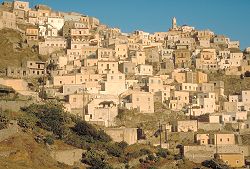 The ancient
acropolis of Arkesea occupies the prominent peninsula
projecting out of the sea. There are cyclopean walls and
ancient greek walls, and foundations of public buildings,
probably temples. Follow up the path from Agia Sophia. The ancient
acropolis of Arkesea occupies the prominent peninsula
projecting out of the sea. There are cyclopean walls and
ancient greek walls, and foundations of public buildings,
probably temples. Follow up the path from Agia Sophia.
The middle
northern part of Karpathos is dominated by the island's
highest mountain range, Mount Kalolimni. There are two vilages
here, Mesohori and Spoa, with their sea side fishing-hamlet of
Lefkos, situated at the site of another byzantine city, of
considerable size. The basilica excavated in the mid '70s at
Lefkos's anchorage was of unusual size, being 60m long.
|
>> Dodecanese Islands : Astypalea,
Halki, Kalymnos, Karpathos,
Kassos,
Kastelorizo, Kos,
Leros, Lipsi, Nisyros, Patmos, Rhodes, Symi,
Tilos.
|
|



)